
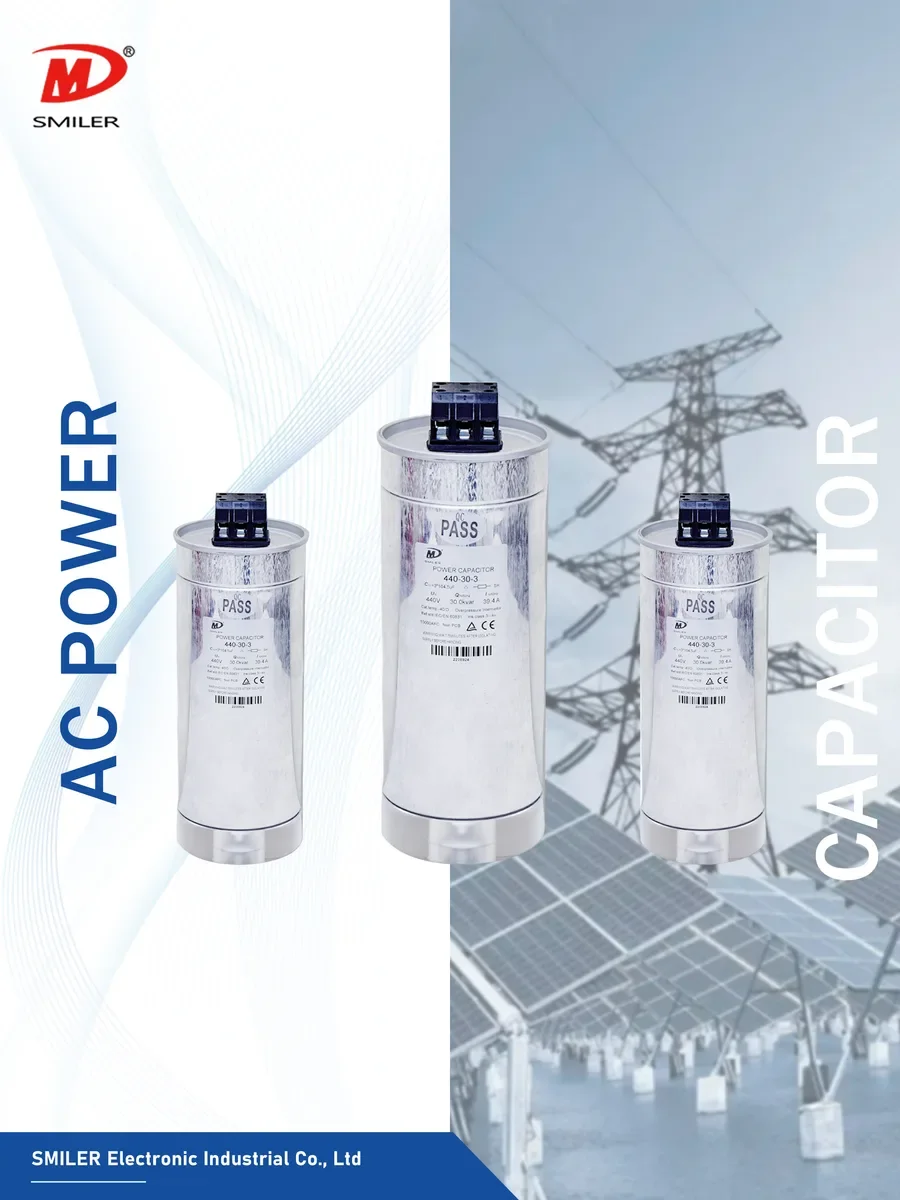
Picking the right ac filter capacitor for a variable frequency drive or a UPS is rarely about capacitance alone. You're balancing harmonic current, switching frequency, ambient heat, and the physical space left on the busbar or the PCB. Get it wrong and you'll see swelling cans, drifting capacitance, or a filter stage that quietly stops doing its job after two summers in a cabinet. SMILER builds three families for this job — the dry MKP-AL, the oil-filled MKP-ALO, and the PCB-mount MKP-AM — and each one solves a different slice of the problem.
Why VFD and UPS Output Stages Need Real AC Filtering
A drive's output isn't a clean sine wave. It's a PWM train with fast edges, and every edge carries harmonic energy your motor windings and your upstream grid both have to swallow. On the input side, a six-pulse rectifier drags a non-sinusoidal current out of the line, and that current distorts the voltage your neighbors see. On the output side, an LC or LCL filter smooths the PWM into something closer to a sine before it reaches the motor.
The capacitor in that filter carries the ripple. It sees the switching frequency, the sidebands around it, and the low-frequency harmonic content all at once. That's a hard life. Electrolytics don't like it, and general-purpose film parts rated for DC will fail fast if you push AC ripple through them without checking the datasheet.
This is where a purpose-built ac filter capacitor earns its place. Metallized polypropylene gives you low ESR, low inductance, and self-healing behavior when a localized breakdown occurs. The metallization clears around the fault and the part keeps working. That's the mechanism that lets these capacitors survive years of transients that would kill a lesser component.
The Three SMILER Families at a Glance
Here's the practical comparison. All three share metallized polypropylene dielectric and self-healing construction, but the packaging and the electrical envelope differ enough that you shouldn't treat them as interchangeable.
| Parameter | MKP-AL (dry) | MKP-ALO (oil-filled) | MKP-AM (PCB-mount) |
|---|---|---|---|
| Construction | Dry, aluminum case | Oil-filled, aluminum case with overpressure disconnector | PCB 2/4-pin, potted |
| Voltage class | Application-dependent (see datasheet) | 300–690 VAC | 250 / 310 / 350 / 400 VAC |
| Capacitance range | 10–300 µF | 5–30 kvar | 0.1–40 µF |
| Frequency capability | Up to 20 kHz | Line frequency (50/60 Hz) reactive compensation | Switching-frequency ripple filtering |
| Temperature range | Per datasheet | Per datasheet | -40°C to +105°C |
| Life rating | 100,000 h @ 70°C | Per GB/T 12747.1/2-2017 | 60,000 h @ VR, 85°C |
| Reference standard | IEC 61071 | GB/T 12747.1/2-2017 | IEC 61071:2007 |
Notice the voltage column. The MKP-AL is specified by frequency capability and capacitance, not by a fixed voltage band — you'll want to confirm the working voltage against the specific part number before you commit. The MKP-ALO is the one with a clear 300–690 VAC envelope and a kvar rating, because it's built for reactive power compensation at line frequency. The MKP-AM sits on the PCB with a tight 250–400 VAC window and a long 60,000-hour life at 85°C.
MKP-AL: The Dry Workhorse for Switching-Frequency Ripple
Say you're building a 100 kW string inverter with an LCL output filter. The capacitor sits between the inverter bridge and the grid, and it has to absorb the switching ripple without overheating. The dry MKP-AL handles up to 20 kHz, covers 10–300 µF, and carries a 100,000-hour life rating at 70°C. That's a solid fit for the mid-frequency ripple current in a modern drive or inverter output stage.
Dry construction means no oil to leak, no orientation constraints, and simpler mounting. For a lot of VFD and UPS designs, that's the deciding factor. You get a lighter part and a cleaner assembly line. The trade-off is thermal: without oil to spread heat, you need to respect the ambient and the ripple current derating curve. Push it too hard and the hot spot climbs faster than the case temperature suggests.
If your filter stage lives on a busbar with decent airflow and your switching frequency is in the low-to-mid kHz range, the dry part is usually the right call. You can review the full MKP-AL specification on the MKP-AL ac filter capacitor page.
MKP-ALO: Oil-Filled for Reactive Power and Higher Voltage
When you're compensating reactive power at 300–690 VAC, the physics changes. You're not filtering a switching ripple — you're shunting fundamental-frequency current to correct power factor, and the capacitor has to survive continuous line-frequency stress plus the transients that come with it. The oil-filled MKP-ALO is built for exactly this, rated 5–30 kvar with an internal overpressure disconnector.
That disconnector matters more than it sounds. If a fault develops and internal pressure rises, the device breaks the circuit before the can ruptures. It's a safety feature you want in any capacitor bank sitting in a cabinet next to other equipment. Oil filling also helps with heat transfer, which is why these parts hold up under continuous kvar loading in a way a dry part of similar size wouldn't.
Use the ALO when your job is power factor correction or harmonic filtering at line frequency in a 300–690 VAC system. It's referenced to GB/T 12747.1/2-2017, the standard for self-healing shunt power capacitors. For a UPS running a harmonic filter bank on the input, this is often the part that makes the difference between a filter that works and one that cooks itself in year three.
MKP-AM: PCB-Mount for Compact Sine-Wave Output Stages
Not every filter stage has room for a can on a busbar. Small UPS units, servo drives, and compact VFDs often put the output filter right on the control board. The MKP-AM is built for that: 250/310/350/400 VAC, 0.1–40 µF, 2 or 4 pins, and a -40°C to +105°C range with a 60,000-hour life at 85°C.
Take a typical 250 VAC 3.0 µF MKP-AM. It shows an ESR of 9.0 mΩ at 10 kHz and handles 6.5 A RMS. Those numbers tell you it's designed for real ripple current, not just DC blocking. On a sine-wave output filter for a small UPS, that's the kind of part that keeps the waveform clean without a heatsink.
The 60,000-hour life at 85°C is worth pausing on. Many board-level capacitors are rated at 105°C for a much shorter life, or at 85°C for a shorter one still. Getting 60,000 hours at 85°C means you can put this in a sealed enclosure and still expect it to outlast the rest of the board. It's referenced to IEC 61071:2007, the same standard family as the larger parts.
If you're filtering harmonics on a PCB-mounted stage, the MKP-AM harmonic filter capacitor page has the full ratings.
Matching the Part to the Job
Here's a simple way to think about it. If you're filtering switching ripple at up to 20 kHz and you have room for a can, the dry MKP-AL is the straightforward choice. If you're compensating reactive power at 300–690 VAC and you need the safety of an overpressure disconnector, the oil-filled MKP-ALO is the right tool. If you're putting the filter on a PCB in a compact UPS or drive, the MKP-AM gives you the ripple current and the life rating in a board-mount package.
Don't mix them up. A dry part pushed into a kvar-compensation role will run hot and age fast. An oil-filled part used for high-frequency ripple filtering won't give you the ESR you need. And a PCB-mount part asked to carry busbar-level current will fail at the pins before the dielectric gives out.
One more thing: check the ambient. All three families have temperature derating, and the life ratings assume you stay within it. A cabinet that runs at 70°C ambient is a different design problem than one at 45°C, and the capacitor you pick should reflect that.
Quality and Certification You Can Verify
SMILER operates under ISO9001:2005 and holds TUV (R 50352497 0002), VDE (40034278), CB (CN36735, CN65200), LVD (AN 50706408 0001), and RoHS (CANEC26003636901) certifications, with SGS on-site verification (489624232_P+T). The manufacturing base in Shunde, Foshan runs 9 production lines with a daily output of around 300,000 units and a finished-product qualification rate of ≥99.93%. You can read more on the quality and certification page.
Frequently Asked Questions
Can I use the MKP-AL for reactive power compensation at 690 VAC?
The MKP-AL is specified by frequency capability (up to 20 kHz) and capacitance (10–300 µF), not by a fixed voltage band. For 300–690 VAC reactive compensation, the oil-filled MKP-ALO is the part designed for that role, with a 5–30 kvar rating and an overpressure disconnector. Confirm the working voltage against the specific part number before you design in either one.
What's the difference between the MKP-AM and a general-purpose film capacitor on the PCB?
The MKP-AM is rated for AC ripple current — a 250 VAC 3.0 µF unit handles 6.5 A RMS with 9.0 mΩ ESR at 10 kHz — and carries a 60,000-hour life at 85°C. A general-purpose DC film capacitor isn't specified for that ripple or that life, and it will age faster in a switching filter stage.
Do these capacitors self-heal?
Yes. All three use metallized polypropylene dielectric with self-healing construction. A localized breakdown clears the metallization around the fault, and the capacitor continues to operate. That's one reason these parts hold up under the transient stress common in VFD and UPS filter stages.
Related Capacitor Series
Need Datasheets or Custom OEM Film Capacitors?
Send your capacitance, voltage rating, and mechanical drawing. Our 9-member engineering team replies within 24 hours with 5-day prototyping availability.